
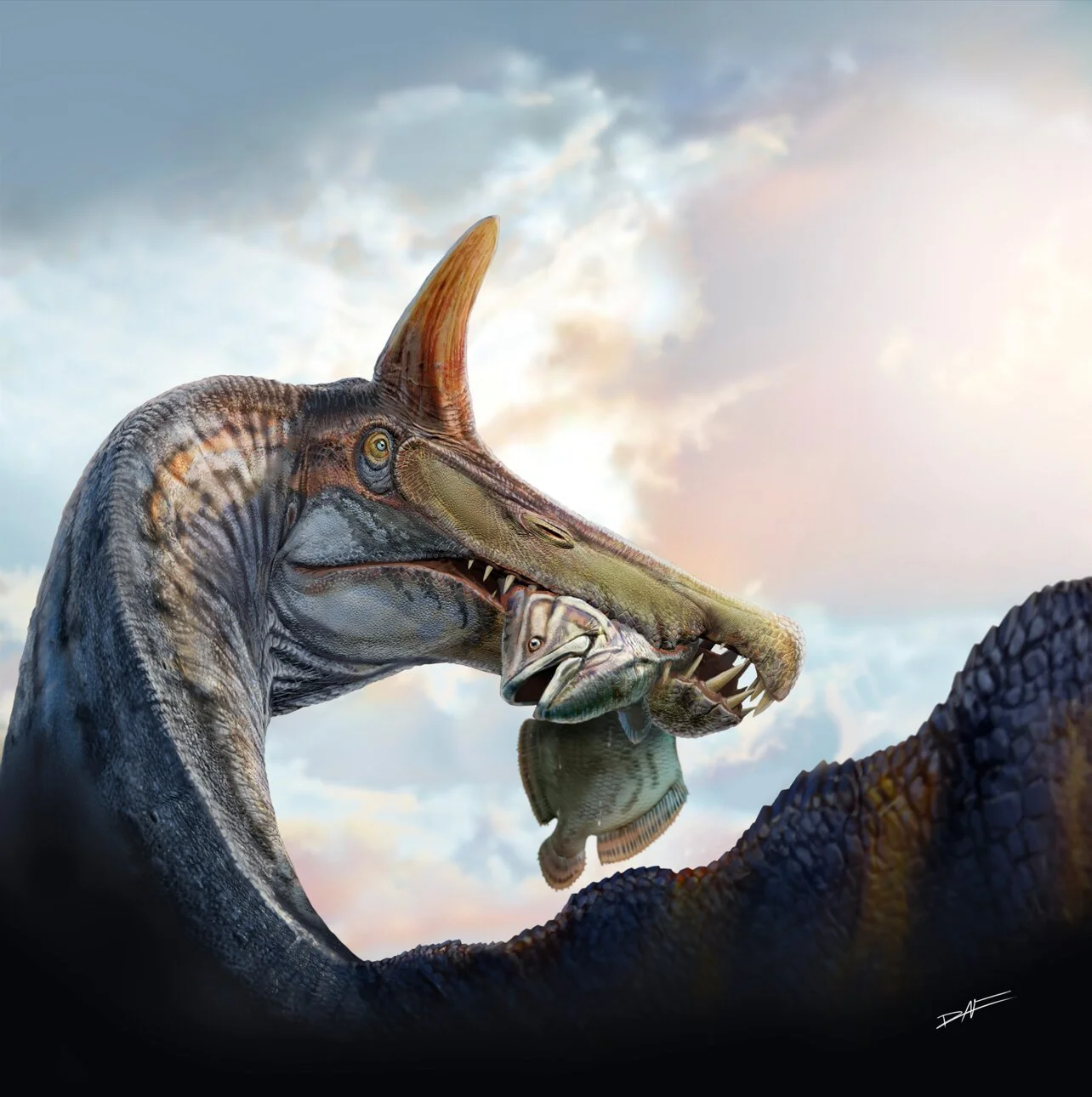
A team of paleontologists has found and identified a new species of Spinosaurus in Niger, revealing a new look at one of the most controversial predators of the Late Cretaceous period. Named Spinosaurus mirabilis, which is Latin for “astonishing” Spinosaurus, was discovered by researchers led by Paul Sereno, a professor at the University of Chicago. The fossils were found at a remote site known as Jenguebi in the Sahara Desert.
The discovery was made possible due to the help of a local Tuareg guide named Abdul Nasser. During an initial scouting trip, researchers had only found a jawbone belonging to Spinosaurus. It was not until 2022, when they returned to the site, did they uncover and identify fossils from Spinosaurus mirabilis and other prehistoric species like Carcharodontosaurus that help give us a better look at how things were in the area, 95 million years ago.
What separates Spinosaurus mirabilis from other spinosaurus, is a scimitar shaped crest on the top of its head. While running CT scans, the team found lots of fossilized blood vessels along with a texture along the surface that suggested the large crest was sheath covered in keratin, leading them to believe it would be mostly used for visual signaling like a birds crest.
Spinosaurus history has been marked with set backs and confusion with the release of Jurassic Park 3. The first Spinosaurus aegyptiacus fossils were destroyed during a British bombing raid on Munich, Germany during World War II. Only a single photograph and detailed drawings survived, leaving paleontologists with limited information until roughly 50 years later when fossil material began appearing, and an even more complete skeleton found in 2014.
Replicas of the Spinosaurus mirabilis skull, featuring the newly found crest, will go on display at the Chicago Children’s Museum on March 1st at 2 p.m. Sereno is scheduled to speak at the event about what researchers are calling a “once in a lifetime discovery.”